




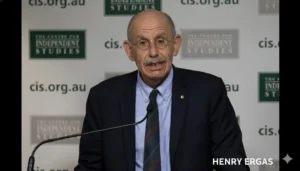
Henry Ergas is among the most respected Australian economists and a policymaker. Being a Professor of Infrastructure Economics at the University of Wollongong and a frequent columnist in the pages of The Australian newspaper, Ergas has influenced the discourse in Australian economic policy by providing incisive commentary on the regulation of infrastructure, cost-benefit analysis and competitive policy frameworks. Ergas (born 22 August 1952), who was made an Officer of the Order of Australia (AO) in 2016, is a rare academic not just in bookish learning, but a hands-on policy guru. His path from Sussex University to the OECD and then to the top of the Australian policy analysis of infrastructure is the story of how intellectual rigour and practical application of policies can create the national discourse.
Who Is Henry Ergas? Understanding an Australian Economic Authority
Henry Ergas is an Australian economist who is a regulatory economist specialising in the practical employment of economic theory to real-world infrastructure and policy issues. As a Sephardic Jew, Ergas introduces a variety of opinions into Australian society and the analysis of policies. His distinguishing characteristic is that, as a practical policy advisor and at the same time an academic scholar, he enjoys dual knowledge. He has never been a mere university office holder but has been a proactive influence on the Australian policy by working in government committees, consultations and influential newspaper columns.
Education and Career Foundation
Ergas graduated with a first-class honours degree in Economics from Sussex University and a Master of Economics with high distinction from the University of Queensland. He started off as a Senior Tutor at the University of Queensland and Macquarie University, teaching Economics between the years 1973 and 1976. Nevertheless, his career took a turn in an entirely different way after joining the Organisation for Economic Co-operation and Development (OECD) in Paris in 1978, and this marked the start of a 15-year transformative era that gave him his global reputation.
Ernas rose up the ranks at OECD until 1985, when he became the head of the Secretary General’s task force on Structural Adjustment, serving the tenure of 1985-1987, during which he designed the world’s international economic policy through its transformation. He was also a teacher in renowned schools such as the Harvard Kennedy School of Government, the University of Auckland and Monash University, which shows that he is of international calibre.
Return to Australia and Policy Leadership
Ernst has left the OECD, and in the mid-1990s, Ergas was a man with unprecedented international experience and policy credibility in his home country, Australia. The Network Economics Consulting Group (NECG), which he established in 1996 and up to 2004, made him an expert on telecommunication, competition policy, and regulation in Australia. His experience turned him into an asset during the time of deregulation of infrastructure in Australia.
His greatest government involvement was when he served as the Chair of, Intellectual Property and Competition Review Committee during the years 1999 to 2000 on behalf of the Attorney-General Department, and the review involved the intellectual property laws in Australia as it was applied in the competition policy. Later, he also served in the Prime Minister’s Export Infrastructure Task Force in 2005 and the Defence Industry Policy Review in 2006, as a political recognition of his analytical rigour on key infrastructure issues and on defence issues.
Academic Positions and Infrastructure Economics
Ergas was appointed in 2009 as the first Professor of Infrastructure Economics at the SMART Infrastructure Facility at the University of Wollongong, where he continues to hold the role to this day. He developed an interest as the leading academic in the field of infrastructure regulation and cost-benefit analysis. His work is on pricing and investment decisions in regulated infrastructure industries- areas that are important to the economic performance of Australia, considering the geographic size of the country and its reliance on efficient infrastructure networks.
The National Broadband Network: Analysis and Controversy
The most notable effect of Ergas in policy making was evidently seen in the debate over the National Broadband Network (NBN) in Australia in the late 2000s and 2010s. Being a leading critic of the NBN policy othe f the Labour government, Ergas introduced rigorous cost-benefit analysis to dismantle assumptions of the Labour government concerning the economic viability of the project.
His analysis also put into doubt the fact that the $43 billion invested in fibre-to-the-home technology would yield enough economic payoffs as compared to the other possibilities of having focused fibre deployment and further upgrading of the networks. Compared to the time, Ergas’ economic critiques were prescient of future challenges in NBN implementation and subsequent cost overruns that demonstrated much of his earlier concerns on project management and cost-effectiveness were correct. This episode demonstrated his intellectual boldness in demanding to question government projects on screen, as well as his overall belief in demanding cost-benefit analysis in public spending.
The Australian Columns: Shaping Contemporary Discourse
Ergas has been a columnist in The Australian newspaper, the major broadsheet newspaper in Australia, since 2006. His columns range across economic policy, infrastructure, defence, social issues and the overall path of Australia to enable him to shape the way educated Australians comprehend complicated policy matters.
His column writing demonstrates Ergas to be not only a technical economist but an intellectual who is writing to the public about issues that are fundamental to the Australian society. Regardless of whether he is examining the policy of the defence industry or challenging the priorities of government spending, his columns are always associated with using evidence and logical consistency rather than political convenience. This has earned him respect on ideological lines. Over the past years, his columns have been more and more concerned with social and cultural questions in addition to the economic policy based on historical interpretation of the current problems.
Honours and Recognition
Ergas was made an Officer of the Order of Australia (AO) in the 2016 Australia Day Honours in recognition of “his outstanding contributions. His official citation was given as his notable service to infrastructure economics, to higher education, to the development and review of public policy, and as a patron of new artists”. This award made him one of the most outstanding citizens of Australia and universal appreciation for his input in the government, academia, and policy communities.
A Voice on Australian Society
In addition to technical economic analysis, Ergas has become an important commentator on the Australian society and social cohesion. Using historical analysis, he has been in a position to look at how the Australian society has changed over the years, from when there were well-integrated institutions to the present times, which are characterised by fracturing and identity tribalism.
In a 2025 speech to the Australia/Israel and Jewish Affairs Council, Ergas told a story that modern demands, such as social media, the deterioration of broad-based organisations in the community, and the weakening of shared Australian patriotism, have radically changed the capacity of society to integrate. His discussion relates economic policy skills to more profound issues of how different societies can stay cohesive despite differences.
Conclusion
Henry Ergas, an embodiment of an influential public intellectual, is an individual who does not want to limit the knowledge within the scope of the profession. Through his experiences at the OECD leading the international economy policy, his work with the foundation of NECG and his work advising governments and corporations, and his current roles as a Professor of Infrastructure Economics and a columnist in the Australian, Ergas has always applied rigorous analytical thought to the most complicated policy debate in Australia.
For Australian readers seeking to understand infrastructure economics, regulatory policy, or the foundations of cost-benefit analysis, the work by Ergas provides essential orientation. With Australia facing problems as diverse as infrastructure renewal to social cohesion, the methods of analysis and historical insights that Ergas’ suggestions are even more relevant today than ever before. His career proves that economics, understood correctly, is not just about numbers but also about the underlying questions concerning the way societies are structured and how they acquire prosperity as well as cohesion.