




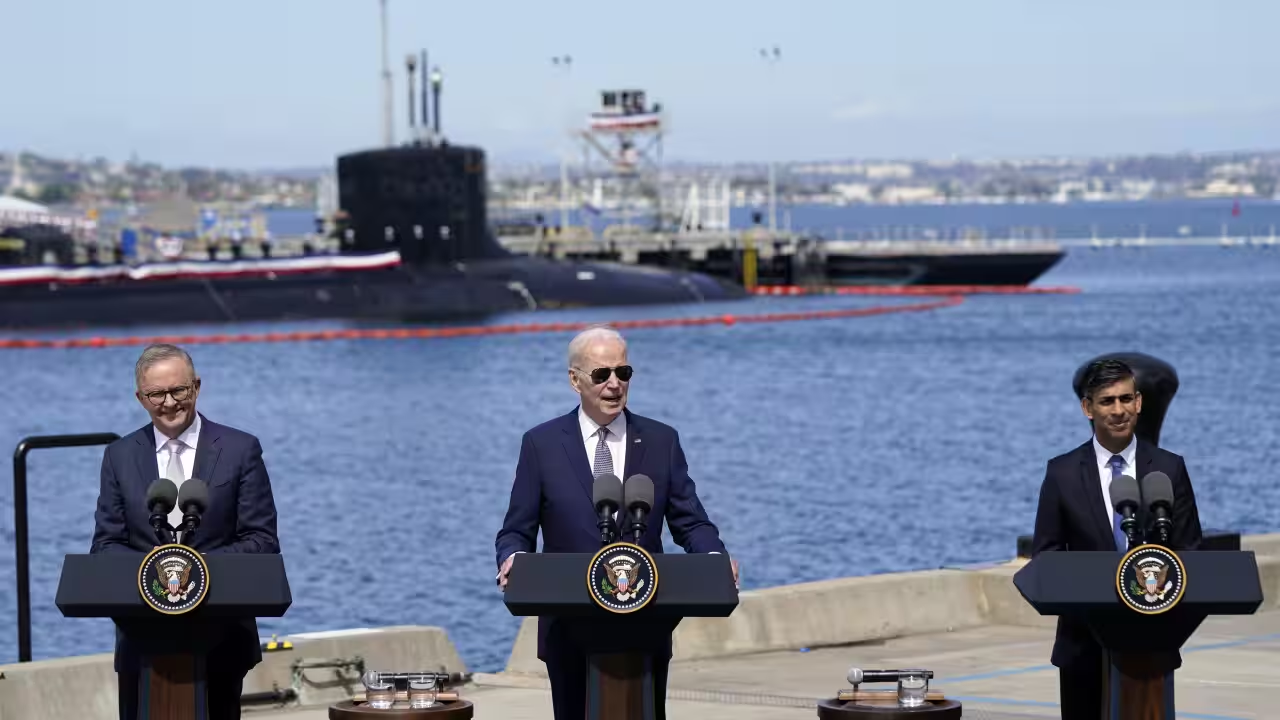
Australia has undergone one of the biggest defence revolutions in its history as its drive for nuclear-powered submarines has progressed from concept to full-scale deployment. An enormous economic, geopolitical, and diplomatic undertaking that is influencing the nation’s destiny in the Indo-Pacific region has grown out of what started as a trilateral statement between Australia, the United States, and the United Kingdom.
A series of announcements during Indo-Pacific 2025 in Sydney demonstrated that the AUKUS underwater pipeline is now a reality. Today, it is a programme that requires ongoing governmental commitment, labour growth, and industry preparedness. However, experts caution that new vulnerabilities, changing regional dynamics, and concerns about Australia’s long-term autonomy in an increasingly complex strategic environment accompany the momentum.
Australia Advances With Submarines Powered By Nuclear
Australia’s desire for nuclear-powered submarines is progressing quickly, as seen by the opening day of Indo-Pacific 2025. Defense officials have emphasised again and again that this commitment is a generational endeavour that calls for ongoing investment, technical discipline, and preparedness throughout the defence industry.
A senior industry executive described the initiative as irreversible, emphasising that Australia had committed to decades of consistent work to guarantee the capability’s delivery once it started along the AUKUS track. The United States is contributing to the collaborative design of the SSN-AUKUS submarine, which is being developed by Australia and the United Kingdom. Advanced battle management systems, a unified vertical launch system, common propulsion plant technologies, and propulsion solutions that can run for the duration of the submarine’s life without needing nuclear refuelling are also included. It is anticipated that the platform would be the most advanced ship Australia has ever used.
The PMB Defence Enhances Australia’s Position in AUKUS
The confirmation of PMB Defence’s participation in providing cutting-edge nickel-zinc battery systems for the SSN-AUKUS class was a significant result of Indo-Pacific 2025. The South Australian business, which now supplies the batteries for the Collins-class fleet, will enter into a more than $34 million deal with BAE Systems in the UK.
This collaboration shows that Australian engineering companies are actively participating in the global supply chain for nuclear-powered submarines, in addition to assisting with domestic maintenance. Another example of how local industry is increasingly integrated into long-term nuclear submarine development is PMB’s incorporation into the SSN-AUKUS design framework.
American and British Submarine Supply Chains Are Open to Australian Businesses
Australian companies now have access to one of the most stringent defence supply chains in the world thanks to AUKUS. Through its joint venture H&B Defence, HII and Babcock have started the Australian Submarine Supplier Qualification programme and moved specialised personnel to Australia. The programme allows successful businesses to directly contribute to the American and British submarine industries by comparing Australian businesses to the exacting requirements of Newport News Shipbuilding in the United States.
After a thorough assessment, a small number of Australian businesses have already received certification. The United States has now directly requested quotes from a number of these companies, indicating a dramatic change in Australia’s defence industrial potential. Australian businesses are developing at a rate that validates the nation’s capacity to sustain a nuclear-submarine ecosystem, according to HII and Babcock.
Lockheed Martin Backs Australia’s Virginia-Class Transition
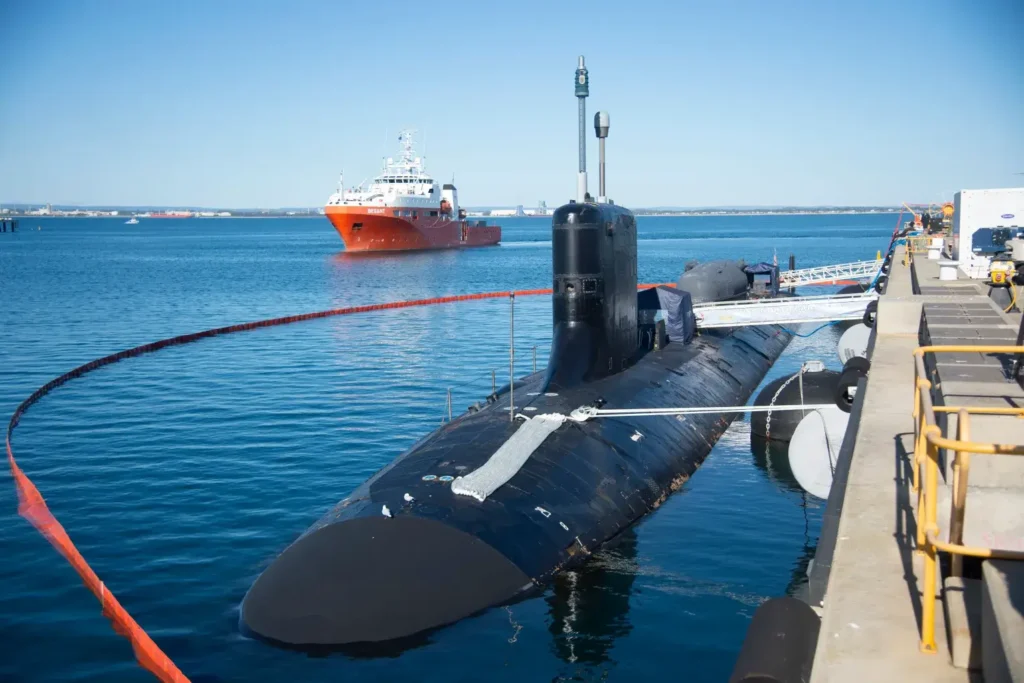
Lockheed Martin utilised Indo-Pacific 2025 to demonstrate its preparedness to maintain the combat management systems used on board Australia’s Virginia-class submarines, which the country plans to employ in the 2030s. The business emphasised that its Australian employees already had the skills necessary to support and maintain these systems at home.
Given that Lockheed Martin Australia had developed the fighting system for the now-canceled Attack-class programme, this capability is noteworthy. As Australia moves from Collins-class submarines to Virginia-class platforms and, ultimately, the SSN-AUKUS fleet, its continued participation guarantees continuity.
AUKUS Pillar 2: Advanced Technology and Unmanned Systems
Emerging technologies including artificial intelligence, cyber systems, quantum sensors, and autonomous underwater vehicles are heavily emphasised in AUKUS Pillar 2. Australia’s subsea activities are anticipated to be redefined by these developments.
The confirmation by HII that the US Navy had successfully launched and retrieved a REMUS 620 autonomous underwater vehicle from a Virginia-class submarine was one of the most important advances. This accomplishment demonstrates how unmanned systems may be used into nuclear-submarine operations, greatly increasing the potential for attack and monitoring. Similar experiments will be carried out by the UK in 2026, while Australia is anticipated to implement the same capabilities in both its current and future fleets.
Additionally, HII and Babcock have formally agreed to work together to integrate REMUS AUVs with Babcock’s launch and weapon handling systems. This strengthens operational consistency and increases trilateral undersea supremacy by opening the door to the potential of a single unmanned underwater system shared by all three AUKUS countries.
Rolls-Royce and the PWR3+ Reactor Powering the Future Fleet
Rolls-Royce has confirmed its longstanding position as a world leader in naval nuclear propulsion by agreeing to provide all of the nuclear reactors for the SSN-AUKUS fleet. In order to construct the new PWR3+ reactor, an advancement of the reactor used in the Royal Navy’s Dreadnought-class submarines, the business is expanding its Derby facility.
The PWR3+ reactor provides unparalleled underwater durability, increased operating flexibility, and enhanced safety. Crucially, it also lessens the need for external power sources by enabling submarines to power themselves when moored. Australia will join the nuclear production and installation chain for the first time when all reactor components are produced in the UK and transported to the Osborne Shipyard in South Australia.
Extensions of Collins-Class Life: Protecting Australia’s Backup Fleet
The Collins-class fleet must continue to be fully competent as Australia waits for SSN-AUKUS submarines to go into service. The life-of-type extension programme has become crucial as a result. The two-year overhaul will extend the operating life of each submarine by around ten years. Raytheon Australia was given a $277 million contract by Defence to maintain and improve the combat systems aboard these vessels.
The AN/BYG-1 system will be modernised, the combat architecture will be strengthened, integration features will be enhanced, and dockside support capacity will be increased. These improvements guarantee that throughout the AUKUS transition, the Collins-class will continue to be a reliable and potent military asset.
Developing Skills for a Nuclear Future: Australia’s Workforce Challenge
Workforce development is one of AUKUS’s main challenges. Australia has never developed the highly specialist capabilities needed to build nuclear-powered submarines on a significant scale. These include systems integrators, sophisticated welders, propulsion specialists, cyber specialists, nuclear engineers, and robotics professionals.
In order to get practical experience that cannot be duplicated via classroom education alone, Australia has started sending individuals to train aboard US Navy Virginia-class submarines. Technical programmes at universities and TAFEs are growing quickly, and new training tracks in advanced shipbuilding and nuclear science are being developed.
Defence officials, however, have repeatedly cautioned that the AUKUS timeframe may slip if there is no substantial increase in the personnel. Training personnel and keeping them in long-term, security-cleared positions that sustain a nuclear capability for decades are both difficult tasks.
Regional Responses: How Australia’s Nuclear Transition Is Seen by Asia-Pacific Neighbours
The Asia-Pacific region has responded to AUKUS in a variety of ways. The deployment of nuclear-powered submarines in regional seas has alarmed a number of South-east Asian countries, particularly Indonesia and Malaysia. Their reluctance stems from concerns about strategic escalation, nuclear safety, and the possibility of igniting an arms race.
Pacific countries, many of whom have had traumatic experiences connected to nuclear testing, have also requested confirmation that Australia’s programme does not present any concerns to the environment or proliferation. Sensitivities are still strong despite Australia’s stress that AUKUS uses nuclear propulsion rather than nuclear weapons.
On the other hand, nations like South Korea and Japan see AUKUS as a component of a larger strategic reaction to China’s increasing aggressiveness. Australia’s move to purchase nuclear-powered submarines is seen by these countries as part of a larger change in the Indo-Pacific power dynamics.
Important Strategic Issues Brought Up by AUKUS
- According to specialists like Wanning Sun, Australia may become a more prominent target in future US-China war scenarios.
- Because the alliance closely aligns long-term security planning with US military aims, it may diminish Australia’s strategic autonomy.
- Concerns about nuclear-powered submarines escalating regional tensions have been voiced by countries in South-east Asia.
- Pacific neighbours are concerned about nuclear safety, environmental hazards, and the regional symbolism of nuclear power.
- Although research indicates that many Australians do not fully comprehend AUKUS’s promises, public support is nevertheless high.
- It’s still unclear whether growing expenses will put pressure on Australia’s overall military budget and long-term investment goals.
Significant Industrial Achievements Made Possible by AUKUS
- A large contract to provide nickel-zinc battery systems for SSN-AUKUS submarines was obtained by PMB Defence.
- The AUSSQ programme has certified eleven Australian companies to Newport News Shipbuilding standards.
- The US submarine programme has already formally requested quotes from a number of Australian vendors.
- All SSN-AUKUS submarines will use PWR3+ nuclear reactors, according to Rolls-Royce, which will install the components at Osborne Shipyard.
- A REMUS 620 autonomous underwater vehicle was successfully launched and retrieved by the US Navy from a Virginia-class submarine.
- The intricate combat management systems used in the next Virginia-class fleet may be maintained by Lockheed Martin Australia.
The China Debate and AUKUS: A Warning from the Wanning Sun
AUKUS has significant diplomatic ramifications in addition to its economic and technological components. According to academic and pundit Wanning Sun, AUKUS radically alters Australia’s strategic independence. In an interview with Crikey’s Cut Through podcast, Sun voiced concerns about Australia’s positioning as a front-line state in the case of increased rivalry between the US and China.
Although Australia has done a respectable job of managing its ties with both Beijing and Washington, she pointed out that the country’s commitment to nuclear-powered submarines cements its place in the strategic orbit of the United States. Her conclusion that “AUKUS makes Australia a target” reflects a rising concern that Australia may now be more vulnerable than it was in the past, both militarily and politically.
Sun further emphasised that rather than a thorough comprehension of the long-term ramifications, popular support for AUKUS may be influenced by oversimplified narratives about a “China threat.”
Conclusion
Australia’s AUKUS route is now firmly in the implementation phase and is no longer only conceptual. The nation is growing its alliances with US and UK defence behemoths, developing new industrial capacities, educating nuclear-qualified people, and getting ready to integrate cutting-edge technology and unmanned systems.
However, these accomplishments are accompanied by an unavoidable strategic reality. In addition to enhancing Australia’s military might, AUKUS changes its diplomatic image and poses concerns about exposure, sovereignty, and regional stability. To make sure that this significant change in military strategy really strengthens Australia’s security, the programme requires cautious leadership, long-term planning, and open communication.
FAQs
What is the latest AUKUS announcement?
Recent AUKUS announcements focus on Australia’s progress toward nuclear-powered submarines, major industry partnerships with the US and UK, workforce expansion, and new technology developments under Pillar II, including unmanned systems and advanced undersea capabilities.
Where is the AUKUS headquarters?
AUKUS does not have a single physical headquarters. Each member nation — Australia, the United States and the United Kingdom — operates its own coordinating teams through defence departments, naval agencies and joint working groups.
Is AUKUS dead?
No, AUKUS is not dead. The partnership is expanding, with new industrial contracts, training programs, submarine design milestones and growing collaboration under Pillar II. All three nations continue to reaffirm their commitment.
What is AUKUS Trump?
“AUKUS Trump” refers to questions about how a Donald Trump presidency may affect AUKUS. While Trump has publicly supported Australia receiving nuclear-powered submarines, analysts note that broader US policy shifts could influence timelines, funding and technology sharing.
What is the latest on missiles in Australia?
Australia is progressing with long-range strike capabilities, including plans to acquire US-made missiles and co-develop advanced systems under AUKUS Pillar II. This includes hypersonics, precision strike, and enhanced defence manufacturing for future missile programs.
AUKUS explained simply
AUKUS is a security partnership between Australia, the United Kingdom and the United States. It aims to equip Australia with nuclear-powered submarines and develop advanced defence technologies such as cyber, AI, quantum systems, and unmanned underwater vehicles.
What does Albanese say about AUKUS?
Prime Minister Anthony Albanese has consistently supported AUKUS, stating that the partnership strengthens Australia’s defence capability, deepens global alliances and supports local industry. He also stresses that AUKUS involves nuclear propulsion, not nuclear weapons.
What is The Guardian reporting about AUKUS?
The Guardian often covers AUKUS from political, financial and strategic perspectives. Its reporting includes analysis of submarine costs, concerns about US political stability, environmental issues, regional reactions and debates about whether AUKUS increases Australia’s strategic risk.