


With the Yarra River cutting through the busy Melbourne streets, where rallies and multicultural pride are the order of the day, one name has sparked fierce debate: Mohammad Sharab.
With the pro-Palestinian activism in Australia exploding during the Israel-Gaza war, the 37-year-old Brunswick-based Palestinian-Australian activist came out as a vocal figure as well as a divisive one. His experience of becoming a leading activist, chanting outside the State Library, to facing harsh criminal prosecution is an insight into the uncertain sensitivity between activism and responsibility in contemporary Australia.
Who Is Mohammad Sharab?
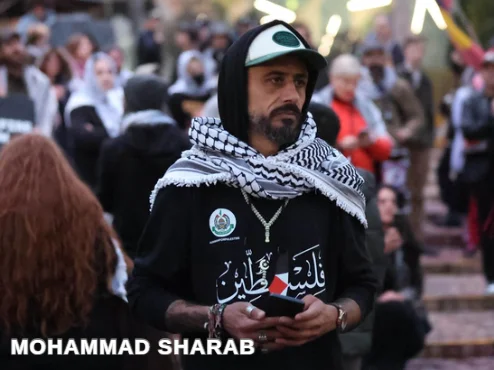
Sharab was born to Palestinian parents and is currently living in the inner north of Melbourne. He was the recognisable face in pro-Palestine protests around Victoria following the escalation of the conflict towards the end of 2023.
Wearing a keffiyeh and waving the Palestinian flag, he would assemble crowds at the Flinders Street marches and US Consulate protests, most of the time addressing what he termed “colonial oppression”.
His advocates say he is an ambitious human rights activist; his critics say he is an agitator who has also overstepped the boundaries of the law and morality. That strain reached a climax in mid-2024, when the government charged him with wearing a banned Hamas emblem on one of his rallies–a criminal offence under new Commonwealth laws which banned terrorist and Nazi emblems.
In Brunswick, where activism is an inseparable part of the suburb’s identity, where student groups, refugee collectives, and community organisers have their presence, the emergence of Sharab was hardly a surprise. He is seen by some locals as a rebellious extension of the left-wing tradition of the suburb; to others, a warning of how political passion can lead to extremism.
The February 2024 Kidnapping and Assault Case
Soon, the activism of Sharab was only shadowed by a much more serious issue.
On 16 February 2024, police claim that Sharab and another 27-year-old human-rights advocate and Al Jannah Foundation founder, Laura Allam, and a man named Ibrahim Al Azhari kidnapped and violently assaulted Nemer Abusamha, a 31-year-old man living in the west of Melbourne.
The victim was reportedly lured through WhatsApp and then kidnapped by masked men, beaten up with a hammer, duct-taped, and injured at Braybrook, where he was later discovered by a passerby.
Several accusations are now raised against Sharab: kidnapping, false imprisonment, armed robbery, threats to kill, and serious injury. The three have all pledged innocence.
In a committal hearing in January 2025, Magistrate Brett Sonnet observed evidence weaknesses in some areas, especially relating to Allam, but ordered all the accused to stand trial in the County Court of Victoria, to begin in the year 2025-26.
Bail Breaches and Court Drama
Sharab was released on bail initially when he was arrested, but this did not last long.
Police accused him in July 2024 of violating his bond by talking to a male co-conspirator at a pro-Palestine rally outside the State Library, albeit against very stringent restrictions that made such contact illegal. Video footage also allegedly had him putting on a scarf to cover his face when talking to the other accused individual.
In one month, Magistrate David Starvaggi ordered the alleged perpetrator, whom he described as “exceptionally and seriously violent”, to surrender his bail, stating that nothing could be the means to decrease the possibility of repeated violations.
His lawyer attributed his loss of relatives in Gaza as a reason during the hearing, but the magistrate refused to grant him release, highlighting the safety of the people and respect for the process of justice.
The “Armed Resistance” Speech and Hamas Symbol Controversy
National attention was given to Sharab when he appeared in public, even as the court case was taking place.
He gave an incendiary speech on the US Independence Day, 4 July 2024, outside the US Consulate in the CBD of Melbourne, calling for “armed resistance” and declaring that “America deserves death.”
The police initiated inquiries into the possibility of a violation of anti-terror and vilification laws. The AFP ended up not charging, although the statements caused a great outcry from politicians and leaders of the Jewish community.
Only one month before, in June 2024, the federal ban on displaying the symbol of designated terrorist organisations had been issued, and photos had emerged of Sharab wearing a Hamas badge at a rally.
Those pictures highlighted a thin line between political speech and incitement to a crime to many Australians.
Confrontations with Rebel News Journalist Avi Yemini
Sharab was also in conflict with the media.
On 30 April 2024, at a protest outside the Parliament of Victoria, he allegedly attacked a high-profile journalist, Avi Yemini of Rebel News. The fight, filmed on camera, depicted some heated words, thrown bottles and physical intimidation.
Sharab was accused of illegal assault and other related crimes. In September 2024, he pleaded guilty to assault and threatening behaviour, saying that he was frustrated by what he considered to be media bias. Sentencing remains pending.
To a lot of viewers, the event underscored the increasing tension between protesters and the press in the frontlines of protests in Melbourne, tension akin to the one in the marches of the Vietnam War.
Community Reaction and Online Presence
Prior to his arrest, Sharab had an active Instagram that was used to promote his activism, film protest videos, and political commentary.
Captions on posts were frequently intense, like “May God have mercy on my enemies, because I will not”, and swords and fire emojis.
The account was deleted by the end of 2024.
Debate over the case of Sharab has raged on Reddit and X (previously Twitter), with some users defending Sharab in the name of just a protest, whilst others issued warnings of extremist undertones.
Some in the Melbourne activist circles remain divided, though some quietly dissociated themselves, and others still claim it is a case of political double standards to prosecute him.
The Larger Picture: Activism, Accountability, and Australian Law
The Mohammad Sharab saga is the convergence point of activism, free speech, and criminal law.
He is a representation of resistance and support to Palestinians to his followers.
He represents the threat of letting violent rhetoric pass as advocacy in the eyes of his critics.
With the County Court trial imminent, Australians are left pondering hard questions:
To what extent does protest go before it is a threat?
And could a country that is founded on the principle of multicultural values unite the fire of activism with the confines of the law?
To this day, Sharab continues to be a lightning rod in the civic life of Melbourne, a reminder that the struggle for justice, no matter how it may be understood, can hardly be achieved without struggle.